
Hoke County Criminal Court Cases
The Hoke County Clerk of Superior Court keeps the public case file for both trial levels. District Court tries misdemeanors and conducts first appearances and other early felony work. Superior Court hears felony trials, usually after indictment or another lawful superior-court charging path. A misdemeanor appeal from District Court reaches Superior Court for a new trial. Raeford has no separate municipal criminal court, so a city charge also moves through these Hoke County courts.
Hoke belongs to Superior Court District 29, District Court District 29, and Prosecutorial District 29. Those district labels identify the judicial structure, but the public file still sits with the Hoke County clerk. The sheriff may hold the incident narrative, yet it cannot supply the court's judgment or certify the prosecution result.
The Hoke County Judicial Branch page identifies the county's court districts and service links. Its official view is shown below.
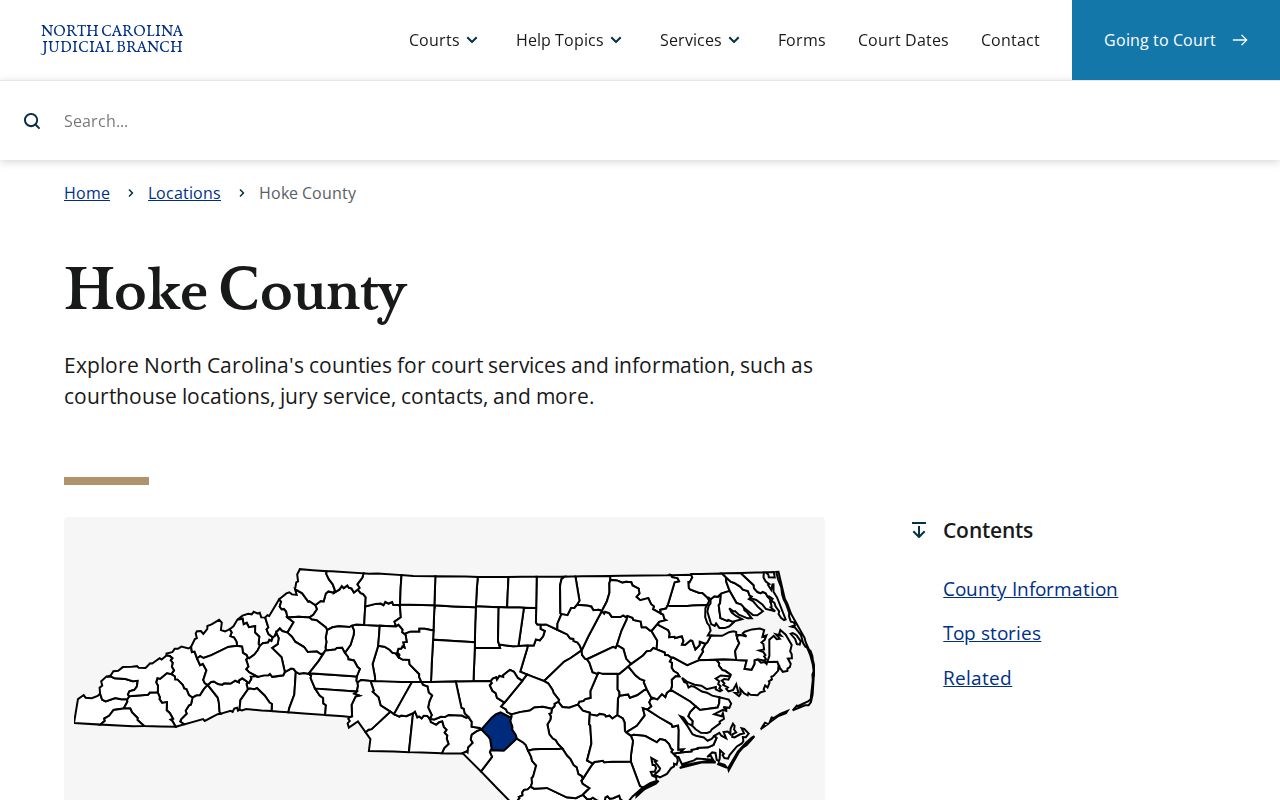
That county page is the sound starting point for calendars and court services, while the clerk remains the custodian of pleadings, judgments, and certified case records.
Hoke Criminal Courts by Level
Court level matters because the same felony can appear first in District Court and later in Superior Court. The file may show a first appearance, release terms, a probable-cause event, waiver, or transfer before the superior-court phase begins. A searcher who opens only one event can miss the rest of the path.
| Office or court | Role in Hoke cases | Contact |
|---|---|---|
| District Court | Misdemeanor trials and early felony proceedings | Judges: 910-722-5012 |
| Superior Court | Felony trials, judgments, and misdemeanor appeals | Judges: 910-266-4575 |
| Clerk of Superior Court | Public files, copies, terminal access, and certification | 910-878-4100 |
| District Attorney | Prosecution and charging work, not neutral record custody | 910-266-4500 |
The official Hoke court directory supplies those office lines and the magistrate number. The directory image below helps distinguish the offices before a caller chooses a records channel.
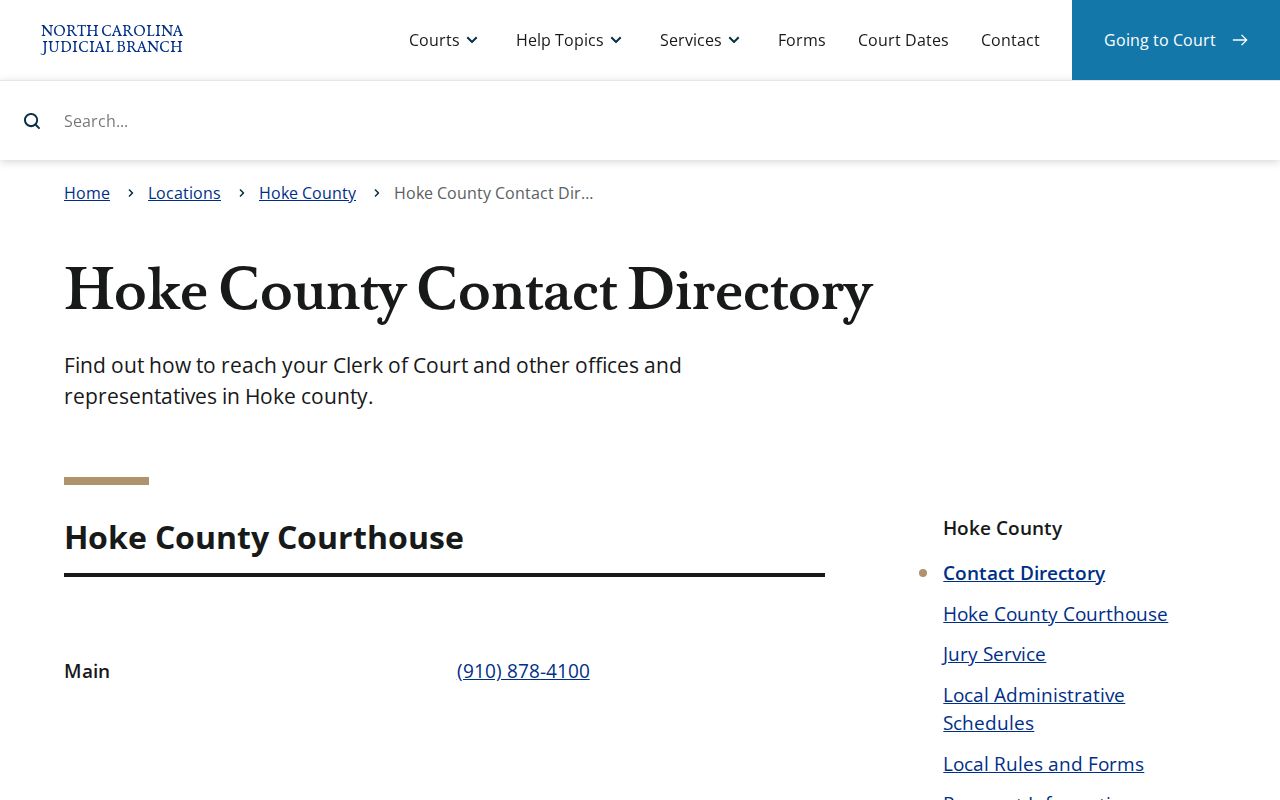
Ask the clerk for a case document or disposition. The prosecutor's office is not the public file counter.
Searching Hoke County Case Records
North Carolina eCourts Portal offers free public case information, but it is one channel in the Hoke County search. The courthouse terminal and paper file are the official fallback when a remote result is missing, hard to match, or incomplete. Certification requires a separate clerk request.
- Open the North Carolina eCourts entry point and choose Portal Smart Search.
- Enter a full party name or known case number. Wildcards require at least three last-name letters and one first-name letter, each followed by an asterisk.
- Use Advanced Filtering to select Hoke County and Criminal Actions. An exact date-of-birth range can help validate a party even though public results mask the date.
- Read the case summary, events, hearings, charge entries, disposition, and financial information. Cross-check Judgment Search when the result calls for it.
- Use the clerk terminal or request the paper file when Portal fails. Ask for a copy by case number and document title, or submit AOC-CR-314 for a certified Hoke-only search.
| Field label | Type | Required | Notes |
|---|---|---|---|
| Smart Search | Text | Yes | Case number or party name by default |
| Location | Dropdown | No | Select Hoke County to localize results |
| Date of Birth From/To | Date range | No | Use the same date twice for an exact check; display stays masked |
| Case category | Dropdown | No | Select Criminal Actions |
| Status and filing date | Dropdown and date range | No | Narrows a broad name result |
| Search Hearings | Separate search | No | Accepts case, party, attorney, officer, or courtroom fields |
The Portal training page documents the search syntax and fields. The captured interface below shows the official training source used for this Hoke County workflow.
Portal works best in Edge or Chrome, and the Judicial Branch suggests clearing the cache or using a private window when the service misbehaves.
Hoke Case Name-Match Traps
A common name can lead to the wrong Hoke County file. Portal masks the displayed date of birth as XX/XX/XXXX and does not validate a Social Security number for public users. Still, an exact birth date can be entered in both ends of the date range to narrow the party match. Compare the court location, filing year, case type, and hearing trail before treating a result as the right person.
The general Party Name filter can also hide useful results because official training warns that it limits results and wildcard use. Start with Smart Search, then narrow through Advanced Filtering. Case numbers are safer when known. Enterprise Justice numbers use a two-digit year, case-type letters, a six-digit sequence, and a three-digit county identifier. Copy the full number from the result rather than guessing any part.
Inside a Hoke County Case File
A Hoke County criminal case file tells the prosecution story. It can show what charge was filed, when hearings occurred, what motions or process entries were recorded, and how each count ended. That is broader than a booking entry, which only captures custody and allegations at intake.
| Case Number & Court | Year, case type, sequence, county identifier, Hoke location, and trial level |
|---|---|
| Charging Record | Filed offenses and statutory references, which may differ from arrest charges |
| Register of Actions | Public events, service entries, motions, and other docket activity |
| Hearings | Date, time, courtroom, and judicial officer when entered |
| Disposition & Judgment | Outcome by charge, judgment status, and index details |
| Financial Information | Public costs, fees, restitution, or other obligations when applicable |
| Documents | Public filings available by access role; not every document appears remotely |
The Judicial Branch's court-record access instructions explain remote, terminal, paper-file, and copy routes. The image below reflects that official source.
Use the case number and exact document title when asking the Hoke County clerk for a pleading or judgment.
Certified Hoke Court Record Search
Portal information is not a certified record. A certified name-based Hoke County criminal record search costs $25 and uses form AOC-CR-314. The result covers Hoke County court records, not every North Carolina county. A mailed request accepts a money order or certified check, but not a personal check. An in-person request may be paid by credit card, cash, money order, or certified check.
Free courthouse terminals can search noncertified criminal records by defendant, case number, victim, or witness. Users may email results and may pay to print them. Copy prices for specific Hoke County documents are not published in the research, so call the clerk before ordering a large file.
The official criminal record search page explains the certified and self-service options. The current form catalog is safer than keeping an old request copy.
How a Criminal Case Moves
Hoke County criminal cases do not all follow one identical track. A misdemeanor can remain in District Court, while a felony begins with early District Court events and later reaches Superior Court. Pleas can resolve either type before trial. Appeals and post-conviction filings can add a later record layer.
Case flow: Charges Filed › Arraignment › Pretrial › Plea or Trial › Disposition › Sentencing
Before the simplified flow, the file may contain arrest or summons process, a magistrate's release decision, first appearance, prosecutorial review, probable-cause work, waiver, or grand-jury indictment. Portal events are procedural entries. They should not be read as plain statements of guilt.
After judgment, the docket may add notice of appeal or post-conviction proceedings. Those later events can affect the case status without rewriting the original charge history, so check the newest entry as well as the disposition row.
Hoke Court Disposition Terms
The disposition column gives the court result for each charge. One Hoke County case may contain several counts with different outcomes, so a case-level label can hide the detail that matters.
- Dismissed
- The prosecution ended that charge without a conviction.
- Not guilty
- A court or jury adjudicated the charge without a finding of guilt.
- Guilty or convicted
- A plea or adjudication produced a conviction and judgment.
- Prayer for judgment continued
- A North Carolina result with special legal effects that should not be called a dismissal.
- Pending
- The charge has no final disposition entered yet.
Read the judgment and charge-level events when a status is unclear. The online summary can help locate the file, but a certified copy from the Hoke County clerk is the stronger source for a formal outcome.
Missing Hoke Case Documents
Not every public document can be opened online. When a Hoke County case appears but the needed judgment or pleading does not, note the full case number and document title. Then ask the clerk for the paper or electronic court file. The courthouse is at 304 N. Main Street in Raeford and operates weekdays from 8:30 a.m. to 5 p.m. The main clerk number is 910-878-4100.
The official Hoke County Courthouse page provides current access and facility information. The captured courthouse view below ties the record request to the correct public counter.
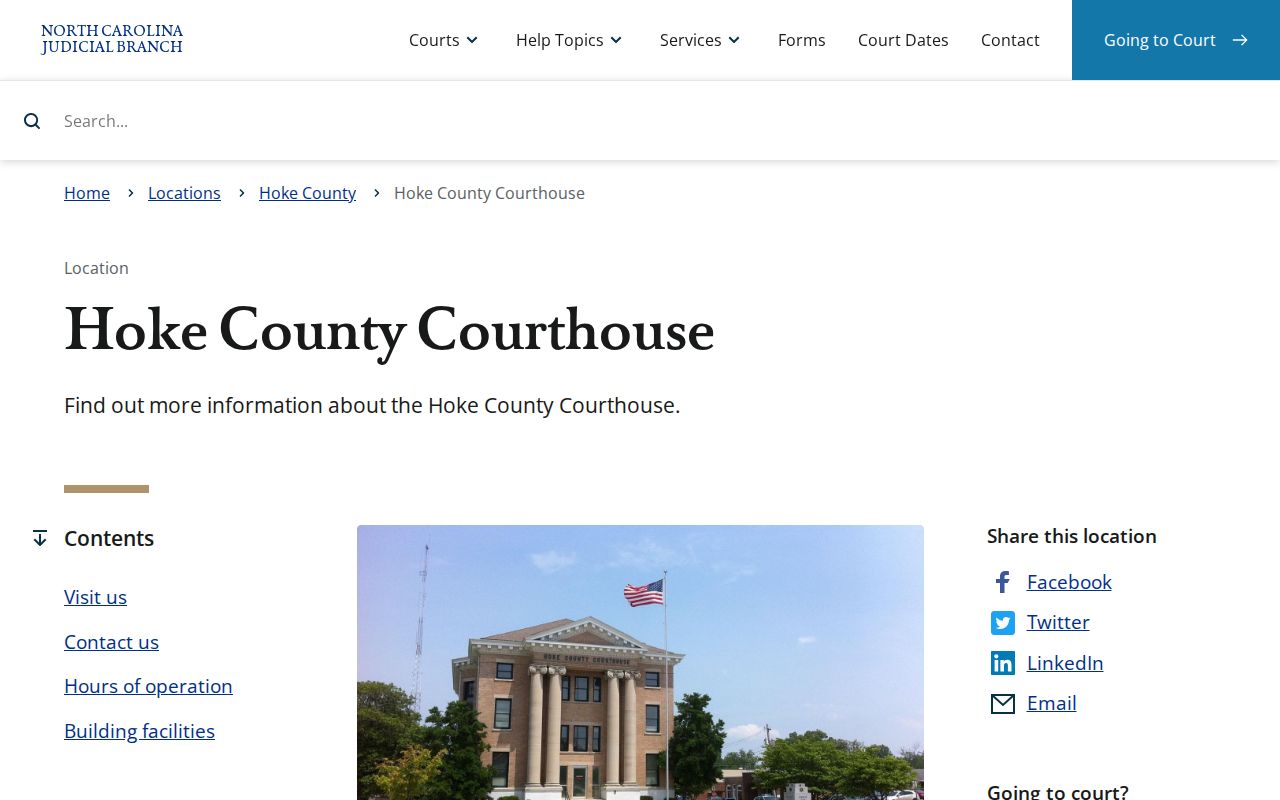
The facility lists wheelchair access and an elevator. Call before bringing recording gear because a detailed electronics policy is not published.
Case Record Access & Restrictions
North Carolina law supports inspection of public court files. G.S. 7A-109 governs court-record access, while the North Carolina Public Records Law supplies a broader public-record framework. Public access does not erase statutes that protect juvenile matters, sealed or expunged cases, protected parties, Social Security numbers, or victim information.
Unreturned criminal warrants are restricted from ordinary Portal access. A public Register of Actions may later show issuance, service, a return as served or unserved, a reset, or recall when that process becomes part of the accessible record. A failed web search does not prove that no process or case exists.
The Judicial Branch criminal forms catalog supplies current court forms. The image below shows that official source for Hoke County case requests.
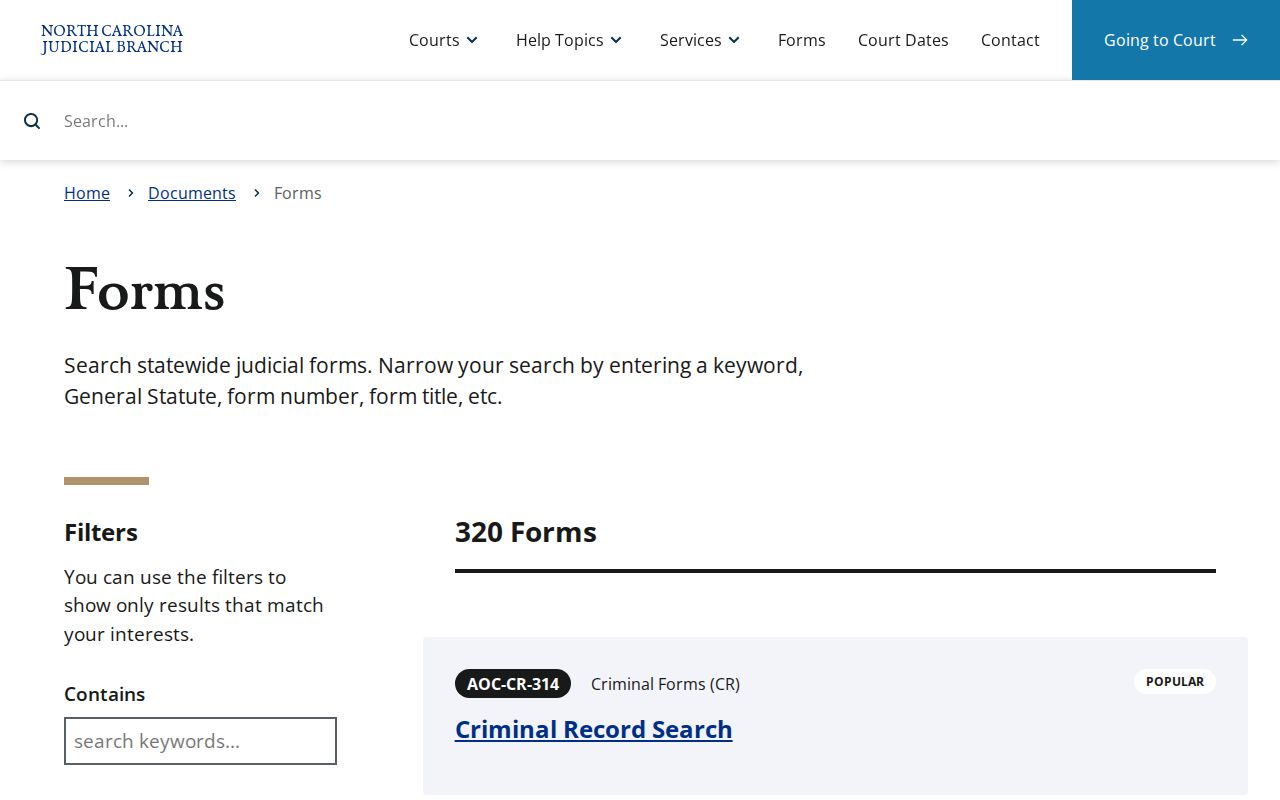
Use the clerk's current form and instructions, since requirements can change and restricted files cannot be opened through a general request.